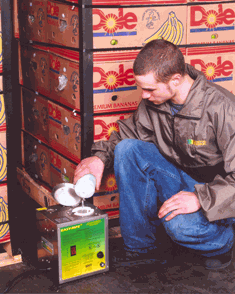
Is it OK to turn the
generator off with Ethy-Gen® II Ripening Concentrate still in the reservoir?
Yes. A small amount may evaporate if left in the generator for a long period
of time, especially if the lid to the unit is left open. However, it is
perfectly fine to turn the generator off when the ethylene application is
complete, leaving any unused Ethy-Gen® II in the reservoir. Also, it is OK
to leave a generator running with no Ethy-Gen® II in the reservoir.
What generator setting should I use?
It totally depends upon several factors: the size of the room, how "air
tight" the room is and number of air exchanges per time period. The chart
below shows the suggested settings for the Easy-Ripe®, Auto-Ripe®, CRS -
Centralized Ripening System® Generators and Smart-Ripe® Generators.
Conversion Rate Settings and approximate room size*:
# 1: 1 Quart of Ethy-Gen® II every 48 hours; 1,500 to 2,499 ft³ (43 - 70 m³)
# 2: 1 Quart of Ethy-Gen® II every 36 hours; 2,499 to 4,999 ft³ (71 - 141
m³)
# 3: 1 Quart of Ethy-Gen® II every 24 hours; 5,000 to 7,499 ft³ (142 - 212
m³)
# 4: 1 Quart of Ethy-Gen® II every 12 hours; 7,500 to 12,000 ft³ (213 - 340
m³)
*It may be possible to use just one generator for a room that is larger
than 12,000 ft³ (LxWxH, 340 m³); it depends upon how tight the room is. We
have found these setting to be applicable for most rooms and provide
sufficient ethylene (150 - 300 ppm) to initiate the ripening process in
bananas, tomatoes and other fruits (except citrus, which requires less than
10 ppm; for this, use our Citrus Generator).
However, some ripeners prefer to take ethylene readings with an
Air Sampling Kit
and select the setting that produces the ethylene level desired. As always,
please contact us
if we can be of service.
Note that for rooms larger than 12,000 ft3, if necessary,
additional generators can be used to achieve the proper ethylene level.
Can I use more than 150 ppm of ethylene to speed up the ripening?
It serves no purpose because the additional ethylene has no effect. Any
ethylene exposure over 150 ppm does not hurt the fruit* but the extra
ethylene provides no benefit. Once the proper ethylene level is attained,
the only thing that will speed up the ripening process is a higher
temperature. Sometime fruit that has been ripened at too high of a pulp
temperature is referred to as "overgassed." Often the cause of poor quality
associated with this misnomer is not excessive ethylene but extreme pulp
temperature at some period in the postharvest life of the fruit, or poor
fruit quality, such as old, stale fruit.
*Note: Citrus is an exception; it cannot be exposed to more than 10 ppm
and the precise ppm level depends upon variety).
I sometimes feel light-headed or find it difficult to breath in a
ripening room during the initial stages of the ripening cycle. What causes
this?
For the first few days of a ripening cycle, fruit takes in a large amount of
oxygen and produces carbon dioxide. This environment therefore can make it
difficult to breathe. Venting of the ripening room, which removes this
buildup Of C02 and replaces it with fresh oxygen, not only makes it easier
for people to breathe in the room but also gives the fruit the fresh air it
needs. C02 inhibits the ripening process and, when not vented out, can cause
uneven and delayed ripening, and, while not very likely, but possibly a
difficult breathing environment.
I hear that ethylene is explosive. How can I be sure that I'm safe from
this danger?
Yes, ethylene is very explosive, at concentrations above 27,000 part per
million (ppm). However, the ripening process of most fruits can be initiated
by ethylene at concentrations as low as 50 ppm, or less than 1 % of the
explosive level, and most operators ripen with 1,000 ppm or less. When using
any of our generators, and following our easy, simple directions, there is
no chance of explosion. As a matter of fact, in a normal one load banana
room (about 3,500 ft³), you would likely need at least 20 of our generators
operating on the highest setting (# 4) to have the potential production of
27,000 ppm.
My bananas are not ripening evenly. What can be causing this?
Uneven ripening is caused by one of at least four things:
- Insufficient amount of ethylene, caused any of these situations:
- Generator setting too low for room size
- Not applying ethylene long enough to trigger the fruit to ripen on
its own
- An air leak, large enough to considerably reduce ethylene levels,
has developed somewhere in the ripening room
- Immature fruit: When harvested, the fruit had not yet reached a mature
stage. In order for fruit to ripen properly, it must be picked when fully
developed and mature
- Mixed lots: a room of fruit that contains various grades, comes from
different origins, or is not uniform in characteristics will usually not
ripen evenly
- Old fruit: When ripening fruit that has been "held" for an extended
period of time after harvest, the ripening results will inevitably vary
and will usually involve uneven ripening, as some of the fruit will begin
to ripen before others. As a general rule with most types of fruit, it is
best to apply ethylene as soon as possible to mature green fruit; this
ensures that all fruit within the room will ripen even and uniformly.
Why does Catalytic Generators make sure that their generators comply with
UL® and TÜV Product Service Standards?
These are independent, not-for-profit, non-governmental organizations formed
to help reduce injury, loss of life, and property damage. To do that their
scientists investigate and test products to evaluate their electric, fire,
and casualty hazards. We felt that, since our generators are electrical
instruments, it would be in the best interest of our customers to ensure
that our equipment is of top quality and workmanship; passing these
stringent safety standards would be the best test. With these marks on our
generators, our customers can rest on the fact that the equipment has been
found to be reasonably free from foreseeable risk of fire, electric shock,
and related hazards.
What is the shelf life of Ethy-Gen® II Ripening Concentrate?
It has an indefinite shelf life; it is best stored in an out-of-traffic area
at temperatures of less than 125°F, and in accordance with local fire codes.